
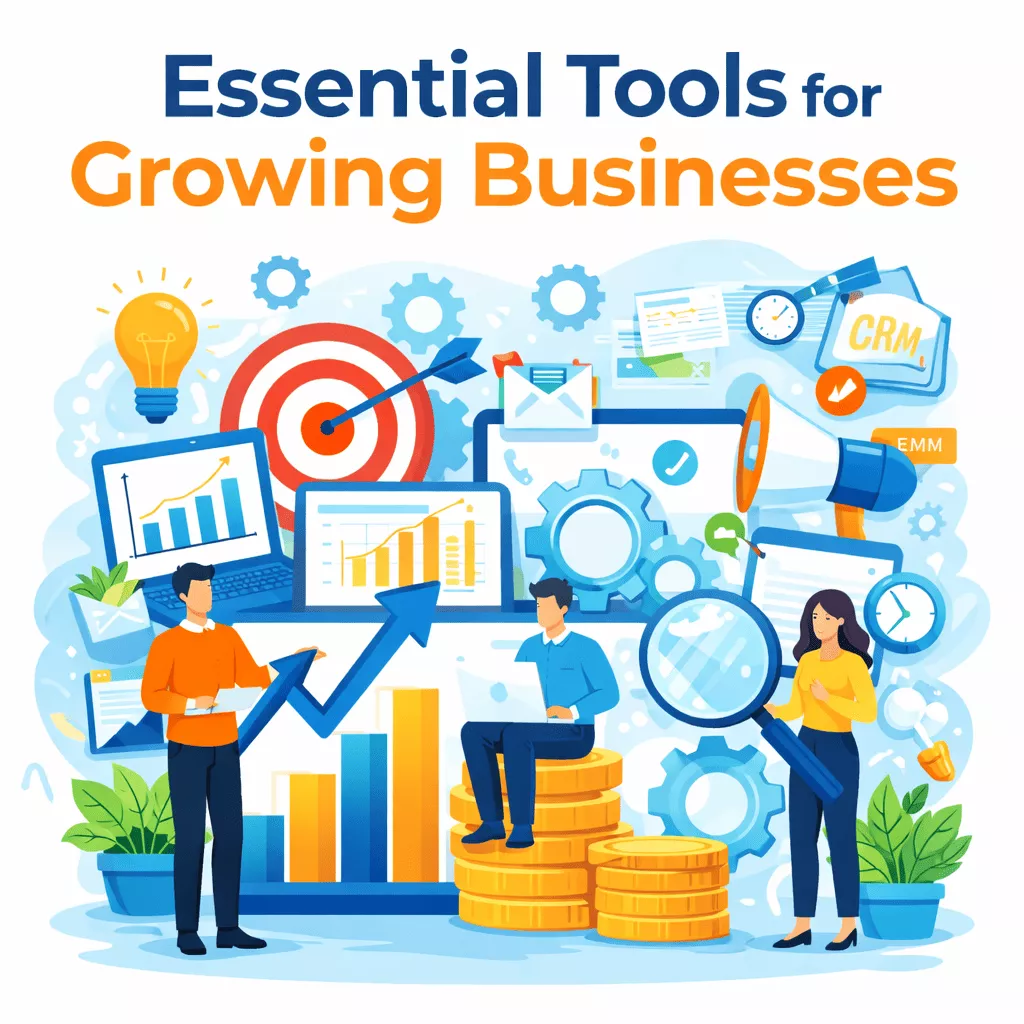
As your business grows, managing operations, marketing, customer relationships, and team collaboration becomes increasingly complex. The right tools for growing businesses help you grow sustainably, keep your processes efficient, and keep your team aligned.
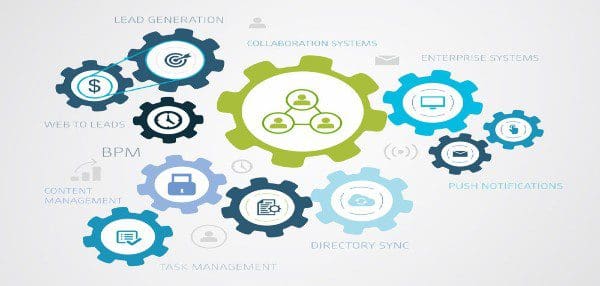
This checklist covers key areas such as CRM tools, CRM automation tools, business automation tools, project management, marketing, analytics, and finance. By carefully selecting a software tech stack, growing companies can eliminate bottlenecks, automate repetitive tasks, track performance, and make data-driven decisions.
Whether you're scaling from a small business to a medium-sized enterprise or preparing to handle larger customer volumes, these tools give you the structure and automation you need to grow efficiently while keeping control and visibility. You can also reference our Business Tools Checklist to ensure you’ve implemented all critical systems.
These online business tools are designed for startups transitioning to growth, where automation, scalable systems, and integrated workflows are critical to sustaining expansion.
CRM & Customer Relationship Tools
- Manage leads, contacts, and customer interactions efficiently
- Popular options: HubSpot, Zoho CRM, Pipeline, Nutshell, and Salesforce
- Benefits: Centralized customer data, improved retention, streamlined sales pipelines
Choosing the correct CRM for your business begins with establishing your goals and a realistic workflow.
Business Automation Tools
-
Automate repetitive workflows, approvals, notifications, and reporting
-
Popular options include Odoo, Asana, ClickUp, Teamwork, Zoho Projects, and Basecamp. If you have multiple platforms and wish to link them, Zapier is a leading tool
-
Benefits: Increased productivity, fewer errors, faster execution of routine tasks
Learn more about Business Automated Tools | View Some Automated Tools
Marketing & Growth Platforms
-
Manage SEO, social media, newsletters, content marketing, and campaigns
-
Popular options: SEMrush, DiiB, Mailchimp, Hootsuite, Buffer
-
Benefits: Targeted campaigns, higher engagement, measurable ROI
Top Marketing Tools for Small Businesses
Advanced Marketing for Leaders
Marketing to Gen Z
Onlne Marketing Tools
Get the books Breaking Boundaries | Engagement: the Art of Social Media
Productivity & Collaboration Tools
-
Streamline internal communication, project management, and teamwork
-
Popular options: Slack, Trello, Monday.com, Microsoft Teams, Google Workspace,
-
Benefits: Better coordination, transparent workflows, real-time updates
Determine or establish the workflow beforehand to guide you in choosing collaboration and communication tools that best fit your organization's processes and goals.
Analytics & Reporting Tools
-
Track business performance, customer behavior, sales, and marketing metrics
-
Popular options: Google Analytics, Tableau, HubSpot Analytics
-
Benefits: Data-driven decisions, performance insights, measurable growth
-
Internal links: Can also link to any analytics blog posts
Financial & Accounting Tools
- Automate invoicing, payroll, payment processing, and bookkeeping
- Popular options: QuickBooks, ZohoBooks, Xero, Stripe, PayPal
- Benefits: Accurate financial management, timely reporting, smooth cash flow
Tips for Implementing Tools in Growing Businesses
-
Prioritize tools that integrate with your existing systems
-
Start with core operational tools first (CRM, automation, marketing)
-
Train your team to use tools effectively
-
Regularly review and optimize tool usage as your business scales
-
Ensure all tools support your growth goals and improve efficiency


FAQs – Essential Tools for Growing Businesses
Q1: What are the essential tools for growing businesses?
A: These are software platforms that help businesses manage operations, marketing, CRM, collaboration, analytics, and finance efficiently.
Q2: Should I use integrated platforms or stand-alone tools?
A: Integrated platforms like Zoho One or Odoo centralize multiple functions, while stand-alone tools may provide deeper functionality. Many growing businesses adopt hybrid stacks that combine integrated systems such as Zoho One or Odoo with specialized stand-alone platforms for advanced functionality.
Q3: How can these tools help scale my business?
A: They automate workflows, improve productivity, provide actionable insights, and reduce operational bottlenecks, making growth smoother and more manageable.
Q4: Are these tools suitable for small businesses planning to grow?
A: Yes. Implementing the right tools early allows small businesses to scale efficiently without disrupting operations.
Q5: How often should I review my toolset?
A: Regularly — ideally every 6–12 months — to ensure tools remain aligned with growth needs, integrations, and evolving business processes.