CRM: How To Streamline Your Business And Supercharge Your Sales Efforts
January 30, 2023
Pipeline CRM
April 3, 2023
Let’s look at the top 5 Reasons to start using CRM systems. and review our top 10 CRMs list. If your business is ready for the next level, a CRM is your key to managing customer data, optimizing sales and marketing processes, and gaining deeper insights into customers’ behavior. Find out in this article why it is essential for any business to start using a CRM, and the top CRMs available on the market!
Introduction to Customer Relationship Management
Introduction to Customer Relationship Management. In the business world, customer relationship management (CRM) is a term that refers to practices, strategies, and technologies that companies use to manage and analyze customer interactions and data throughout the customer lifecycle.
The goal of CRM is to help businesses nurture stronger relationships with their potential and existing customers through improved and timely communication and a better understanding of their needs and preferences. In turn, this can lead to improved customer satisfaction, loyalty, and retention rates.
There are many different CRM software solutions available on the market today and we’ll look at what we determined to be the best options depending on your type of business, including such differentiators as price, functionality, addons, scalability, and integrations.
What AI-Enabled Tools and Features Can CRM Systems Provide?
As CRM technology evolves, artificial intelligence (AI) is rapidly becoming a game-changer for how businesses interact with their customers. Modern CRM systems now come equipped with a host of AI-driven features that do more than just manage contacts—they help you work smarter and make your processes more efficient.
Here are some key AI-enabled tools and features you’ll find in today’s leading CRMs:
- Automated Lead Scoring: AI can evaluate and prioritize leads based on past engagement, behaviors, and potential to convert—saving your sales team time and focusing their efforts where they’ll have the most impact.
- Sales Forecasting and Opportunity Insights: Machine learning can sift through your sales data to predict deal outcomes and recommend actions that might tip the odds in your favor.
- Intelligent Virtual Assistants & Chatbots: Many CRMs now include digital assistants to handle straightforward customer requests—think checking order status, answering FAQs, or processing basic transactions—freeing up your staff for higher-level work.
- Advanced Audience Targeting: By leveraging AI-powered data analysis, you can uncover detailed information about your audience, spot new trends, and launch more precise marketing campaigns.
- Personalized Communication Timing: Smart systems analyze user engagement patterns to determine the optimal time and channel to reach out, making your marketing messages more likely to hit the mark.
- Ideal Customer Profile Creation: AI crunches through your past successes to build profiles of your best customers, helping you find and target similar prospects more efficiently.
- Contextual Insights for Sales Conversations: Leading platforms provide real-time suggestions so your team can have more relevant conversations, whether they’re composing emails or picking up the phone.
These AI tools don’t just save time—they empower you to better understand customer needs, spot opportunities early, and deliver more targeted, meaningful experiences.
If you’re not already using a CRM system in your business, there are several compelling reasons why you should start doing so now:
1. Improve Customer Service – With a CRM system in place, you’ll have all of your customer’s information readily available in one centralized location. This will make it easier for your team to provide fast and efficient customer service. One member can pick up with the other left off, with available notes to quickly get up to speed on the issue at hand. Some of the CRMs we will discuss below also have (or integrate with ) ticket systems. which is the best way for customers to request help on a certain issue.
2. Increase Sales & Revenue – By tracking customer interactions and analyzing buying patterns, you can more effectively target cross-sell and up-sell promotions to existing customers. while nurturing sales and marketing efforts toward potential buyers. This can lead to increased sales and revenue for your business.
3. Boost Customer Loyalty & Retention – A good CRM system can help you keep track of important customer details like birthdays and anniversaries. This allows you to stay top-of-mind with your customers to either remember them on their special days and/or provide promotions and/or discounts.
4. Simplify Reporting & Accurate Forecasting – Without a CRM system, the process of generating sales and customer reports often turns into a manual chore—think endless spreadsheets, version control nightmares, and details slipping through the cracks. When data is scattered or outdated, it’s easy to make errors that can throw off your business forecasts or lead to wrong decisions.
A CRM eliminates these headaches by storing all your customer interactions and sales information in one easy-to-access location. This centralization not only streamlines administrative tasks but also ensures your team is always working with the most up-to-date numbers. That means you can trust your reports, make smarter plans, and free up your staff to focus more on what matters most: building relationships and growing revenue.
5 Reasons To Start Using CRM Systems
A CRM, (or customer relationship management system), should be a part of your operating business ecosystem. As we’ve noted in many articles, time is money. And automation saves you time.
Automation is to your time what compound interest is to your money.
– Rory Vaden
Spotting the Signs: Customer Service Metrics That Scream for a CRM
Curious whether your customer service team is due for a CRM upgrade? Here are some telltale signs that the status quo isn’t cutting it:
- Declining Customer Retention
If customers keep slipping through the cracks, or contracts aren’t renewed as often as they used to be, that’s a red flag. A CRM empowers your team to track every interaction and identify at-risk accounts before they leave for good. - Low Customer Satisfaction Scores
Metrics like Net Promoter Score (NPS) or customer satisfaction ratings paint a clear picture. If those numbers are trending downward, it’s a strong indicator you’re missing key opportunities to resolve concerns quickly and build lasting customer relationships. - Long Resolution and Response Times
When average response times or time to first reply start inching up—or worse, climbing to new highs—it’s a sign your agents can’t access information efficiently. A CRM system ensures that every detail your team needs is at their fingertips, allowing them to resolve issues rapidly. - Overwhelmed Support Staff
If your customer service reps spend more time scrambling for details or repeating efforts already tried, a CRM with features like automated case routing, chat integrations, and internal knowledge bases can transform chaos into efficiency.
With these metrics in mind, investing in a robust CRM—like HubSpot, Zoho CRM, or Salesforce—means your team will be better equipped with:
- Automated assistants to address common questions and free up human agents for more complex needs
- Comprehensive knowledge libraries, so answers are just a click away
- Multichannel support tools, including live chat and video, ensuring your customers can reach you how and when they prefer
Investing in a CRM isn’t just about efficiency—it’s about setting your business up to consistently exceed customer expectations.
Missed Opportunities with Unknown High-Value Accounts
When your business doesn’t know which customers contribute the most to your bottom line, it’s all too easy for important accounts to slip through the cracks. Without clear visibility into your top clients, you risk missing out on opportunities to provide personalized service or meaningful recognition—leading those valuable customers to feel overlooked or underappreciated.
This lack of insight can cause several issues for your business:
- Missed Personalization: If your team can’t easily identify high-value clients, it becomes practically impossible to tailor offers or communications specifically for them.
- Inconsistent Service: New team members or departments may not realize they’re interacting with a key account and could provide generic responses instead of the VIP treatment your best customers deserve.
- Lost Revenue: Failing to recognize and nurture these relationships may push high-value customers toward competitors who do a better job of acknowledging their loyalty.
With a CRM system, all this vital customer information is stored in one accessible place—helping you avoid these pitfalls by keeping your top accounts front and center for every member of your team.
What is the ROI of Implementing a CRM System?
When it comes to making the most out of your investment, a CRM system can be a real game changer. While you might be tempted to stick to spreadsheets and email threads when you’re just starting out, growth quickly exposes the cracks in that approach. Research from Nucleus found that for every dollar you put into a CRM, you could see nearly $9 in return. Not too shabby for a tool that’s doing a lot of the heavy lifting behind the scenes!
But it’s not just the dollars and cents. CRM systems consistently boost the efficiency of sales, customer support, and even your marketing efforts:
- Teams who embrace CRM often report over 50% more proposals being delivered—and more of those converting into real business.
- Sales teams find themselves exceeding quotas more consistently, both as a group and individually.
- Lead conversions can jump by as much as 23%, meaning more prospects turn into paying customers.
The bottom line? A CRM doesn’t just crunch numbers. It provides the structure that helps your team win more often, reach new heights, and spend less time wrestling with data and more time closing deals.
Of course, ROI isn’t the only yardstick. You’ll also want to keep tabs on other important indicators—like net promoter score (NPS), customer acquisition cost (CAC), sales cycle length, marketing campaign results, and the steady health of your email lists. All told, a CRM system isn’t just an expense; it’s an investment with the potential to deliver serious value as your business grows.
While there are many benefits to using a CRM, perhaps the most important are that it manages and tracks your sales and improves your marketing strategies. With a CRM in place, you will have a central database where you can store all of your customer information. This information can be used to create targeted marketing campaigns that are more likely to convert leads into customers. Some CRMs have built-in auto-trigger functionalities so that you can:
- Auto-respond to visitors on your website
- Set up a drip email cadence (prewritten emails that are sent to the target on a rescheduled cadence.
- Build an email list
- Develop an integrated newsletter, and
- some CRMs integrate with automated social media posting.
In addition, by tracking your customer interactions, you will be able to identify any areas where your sales or customer service processes could be improved. You’ll be able to keep track of your customer interactions., get to know your customers better., increase sales and close more deals, and automate your marketing efforts. and stay organized and efficient.
If you build a Knowledge Library (FAQs, articles, or videos) to send customers to when they send support tickets to inquire about certain common problems, This will free up your staff to focus on more important tasks, such as developing new products or providing one-on-one support to customers. In addition, by having all of your customer data stored in one central location, you will be able to save time when dealing with any given customer.
Measuring CRM Effectiveness: Key Performance Indicators to Watch
When it comes to gauging the true impact of your CRM, looking solely at ROI is a bit like judging a car’s performance just by the color of the paint. There are several other crucial metrics that give you a holistic view of how well your CRM is driving business growth and customer happiness.
Some of the most valuable KPIs to track include:
- Customer Satisfaction Scores (CSAT or NPS): These help you understand how likely your customers are to recommend you to others or return themselves—a great signal of long-term loyalty.
- Customer Acquisition Cost (CAC): By keeping an eye on how much you spend to bring in each new customer, you can fine-tune your marketing strategies for better efficiency.
- Sales Cycle Length: Shorter sales cycles often mean your CRM is helping your team stay organized and productive, getting deals over the finish line faster.
- Marketing Campaign Performance: Track how specific outreach efforts or automated email cadences are converting leads to customers.
- Growth of Your Contact List: A healthy, expanding database of engaged leads and customers signals that your CRM is facilitating lasting relationships and helping your business grow.
Monitoring these KPIs will shine a light on whether your CRM is delivering the returns you expect—or if it’s time to retool your approach.
Reasons Why Every Business Should Use a CRM Now
If you’re not using a CRM in your business, you’re missing out on a lot of potential customers and sales. Here are some of the top reasons why every business should be using a CRM:
1. Keep track of your customer interactions.
2. Get to know your customers better.
3. Increase sales and close more deals.
4. Automate your marketing efforts.
5. Stay organized and efficient.
– Increased sales and revenue
Sales and revenue are the lifeblood of any business. If you’re not generating enough sales, your business will eventually fail. This is why it’s so important to have a CRM system in place. A good CRM system can help you increase sales and revenue by:
1. Helping you better manage your customer relationships – A CRM system can help you keep track of your customer interactions, so you can follow up with them more effectively and build stronger relationships. This is for existing customers that you want to cross or up-sell, as well as new prospects.
2. Helping you close more deals – A CRM system can help you track your sales pipeline and make sure that deals are getting closed. It provides a task system with reminders so that no potential (or existing) customer falls between the process cracks. It can also help you identify potential roadblocks so you can address them before they become problems.
3. Giving you insights into your customers’ needs – A CRM system can give you valuable insights into what your customers want and need, so you can tailor your products/services to better meet their needs.
4. Helping you improve customer retention – A CRM system can help you keep track of customer satisfaction levels (as some have built-in rating systems) and take action to address any issues that may arise. This will help reduce customer churn and improve customer retention rates.
– Easier marketing campaigns
In today’s business world, marketing is a huge undertaking. When you recognize that marketing is solely about telling a story, then you begin to understand that all the terms you hear bantered about — Search Engine Optimization, local SEO, directory management, Social Media marketing, sales funnels, PPC, and PR, to name but a few — are simply the tools and tactics to tell the story.
Your CRM system is an essential tool for managing a marketing plan. Depending on the features of your CRM, some provide the ability to map a BPM (business process management), and pipeline blueprint that streamlines and automates the marketing process. For example. you can automate it so that any visitor captured on your website drops that customer’s email into a newsletter list; that list can be arranged by content tops, services, or leads vs customers.
The automated rules in a CRM can also notify your sales team, or a customer, based on certain benchmarks that are triggered by a customer’s purchase history. And for prospects, gentle updates and reminders keep your business top-of-mind. We’ve all experienced seeing a product/ service offer repeatedly (whether via email or video, etc.) until we were compelled to purchase. I just signed up for two new SaaS platforms this week alone.
– Streamlined communication with customers
The modern customer has high expectations when it comes to the level of service they receive from businesses. In order to meet these expectations, businesses need to have a streamlined system for communication.
A CRM system can provide this type of communication by keeping track of customer interactions and providing a central repository for customer information. If you’ve ever had a long string of email interactions with a client you know how conversations can become entangled and emails misplaced — especially if there is a gap of time between one communication and another.
Moreover, with the sheer volume of information that comes at us these days, a way to organize it all is essential just to remain sane. It requires a system that can capture new leads (from email, website, or social media visits) and convert them into contact profiles (prospects, customers, vendors, etc). Further interaction can then be categorized into requests or problems, and auto-create tasks accordingly. This allows businesses to quickly and easily respond to customer inquiries and provides a way to proactively reach out to customers with information about new products or services.
— Addressing incomplete or messy customer data
One of the biggest obstacles to effective communication is dealing with incomplete or inaccurate customer information. If you’ve ever tried to follow up with a lead only to realize you’re missing key details—or discovered you’re accidentally emailing the same person twice under different spellings—you know just how frustrating and inefficient bad data can be.
Modern CRM systems tackle this problem head-on. Many automatically pull in and cross-reference contact information from multiple sources, filling in missing gaps and scrubbing out duplicates. This not only saves your team hours of tedious data entry, but also ensures that everyone—from sales to support—has access to the most accurate, up-to-date view of every customer. Clean, complete data means smoother handoffs, fewer embarrassing mistakes, and ultimately, a better experience for the people you serve.
10 Top CRMs for Small Business
There are a lot of CRM systems out there, but you don’t need the best CRM; you need the best CRM for you. We’ve compiled a list of what we believe to be the top options. However, our suggestion is to separate the systems with the features you want and need first, and then compare those for functionality features, intuitiveness, and comfort. What we may find visually easy you may see as cumbersome, so perhaps one of the others will provide a better layout for you. Though I’m quite sure that one of these will work for whatever your criteria might be.
So with that in mind we’ve listed below the top 10 systems to consider, notating which we use (or have used) with pros and cons. Before you can set up your CRM however, you need to define your marketing plan. Need help, speaking with a marketing agency to help define the narratives, content development, and actions.
Of the systems we’ve used, and/or are using, there is one big consideration we deem to be important: Auto-responding, and then expanded functionalities. So below, we’ve listed in the first grouping sites we’ve used or currently use ourselves.
SYSTEMS WE’VE USED
1. 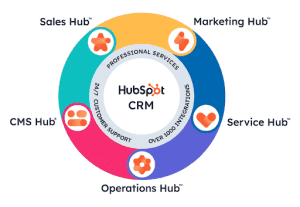 HubSpot Sales CRM: this is a great choice for small and large businesses. For a small business, it is cost-effective for those that want to start out small with the ability to scale so that they don’t have to switch as they grow. It offers a free plan for up to 2 users, and paid plans start at $50 per month. However, note that if you scale into a full-blown CRM and marketing subscription, it can cost as much as $800 a month. And if you’re using it solely for marketing, sales, and customer management, this is the Cadillac. And yes, we do have an account with them. For a free consultation to see if HubSpot is right for you, click here Read more information. or request a free demo here.
PROS:
PROS: a fully integrated full-cycle marketing and CRM platform. It has a brilliant integration with Google Gmail. It is intuitive and provides a good ticket support system, enriched customer data, a landing page, lead capture widgets for your website, and plenty of reports. If you want a platform solely for the purpose of customer relations, sales, and marketing initiatives, this is the Cadillac of the industry.
But the perks don’t stop at shiny features. Companies of all sizes can benefit from a truly integrated, cross-functional CRM. Every interaction through such a system isn’t just a transaction—it’s a chance to deliver a more personal, engaging experience that builds brand equity, improves satisfaction, and drives loyalty (and revenue).
The return on investment is impressive. Even though small businesses might be tempted to cobble together contact lists with spreadsheets and email, that patchwork approach quickly runs into limitations as you grow. In fact, according to Nucleus Research, the ROI for CRM systems hit $8.71 for every $1 spent, and with integration across your other platforms, businesses see productivity boosts across sales, service, and operations—sometimes as much as 20% to 30% growth.
And for the numbers people: organizations that go all-in on CRM report up to 52% more delivered proposals, a 23% higher lead conversion rate, and a notable jump in both individual and team sales quota attainment. In short, integrating a robust CRM doesn’t just organize your contacts—it transforms your business.
CONS: For a small business, it can get pricy to utilize the breadth of the system’s capabilities, costing as much as $800 a month.

Click to enlarge
2. Zoho CRM: This is another great option for small businesses. It offers a free plan for up to 10 users, and its paid plans start at $12 per user per month. Moreover, it is VERY robust and can scale with your team. Contact us for more info click here. or get Zoho One HERE.
PROS: It is the most affordable among the most robust of the CRMs out there. It integrates with other Zoho modules, as well as 3rd party apps. While it provides the standard CRM capabilities — leads, contact network management, business management, email management, sales and marketing automation, and analytics & reports system, it is highly customizable and has a built-in BPM (business process management) capability to create pipelines and blueprints to build your full-cycle macro architecture with preset triggers to not only optimize certain parts of your sales, marketing, and support process but connect it all together.
The other reason we like Zoho so much is that via Zoho One, for approx. $40 a month per user, supports your entire company-wide operations and uses 40 fully integrated modules, including but not limited to CRM, Books (billing and accounting), Subscription management, Project Management, Private Social Networks, HR, Video conferencing, Campaigns, Desk support, and Website Chatbox, and much much more — a full company-wide operating system.
What really sets Zoho apart is how these modules work seamlessly together, becoming the central hub for all your business processes. By bringing sales, customer service, marketing, and even back-office functions like billing, inventory, or logistics under one roof, Zoho One helps eliminate those frustrating communication gaps that often leave customers repeating themselves or watching important details slip through the cracks. With a shared data model, your entire team—regardless of department—can access, update, and collaborate on customer information in real time. This not only unifies your customer experience, but also boosts productivity, breaks down data silos, and transforms your company into a truly data-driven organization.
CONS: It can be complicated to set up, although they do provide live video chat onboarding, and we can also configure it for a fee (including setting up the book and chart accounts, etc) after the free onboarding period is over.*
CONS: It can be complicated to set up, although they do provide live video chat onboarding, and we can also configure it for a fee (including setting up the book and chart accounts, etc) after the free onboarding period is over.
3.  PipelineCRM: this is a terrific CRM. We used it ourselves previously when we needed only a CRM/ sales tool. It was very powerful and one of the easier (to me) systems to be able to see the full sales landscape easily. Visit their site for more information.
PROS: It provides a free trial so you can see what you’re getting. Fully integrates with Google and other 3rd party platforms and has very easy-to-view screens and easy-to-use features.: sales pipeline, contact management, lead management, onboarding, sales team management, and customer care.
CONS: While it does have automated task triggers it didn’t (as of our last review a year or so back) have automated email triggers.
4. Nutshell is another really intuitive and has easy-to-view screens and easy-to-use features. Visit the site here.
PROS: fully integrates with Google and other 3rd party platforms, has very easy-to-view screens, and easy-to-use features.
CONS: While it does have automated task triggers it didn’t (as of our last review a year or so back) have automated emails triggers
5. Bitrix24 is more of a full operating system, with CRM, private employee social network, and project & task management, among other things. A very good operating tool for small or large businesses to access everything in one place. It is really intuitive and has easy-to-view screens and easy-to-use features with 3rd party integrations. Visit the site here.
PROS: It has a free version (without limitation), fully integrates with Google and other 3rd party platforms, and has easy-to-view screens and easy-to-use features.
CONS: The CRM is not as robust for sales and marketing as some of the others, but delivers many extended operations features that the other don’t have.
SYSTEMS WE HAVE NOT USED
5. SalesforceIQ CRM: This CRM is still a leading platform, it has a starter plan of $25 per month for small businesses and scales up to $1,250 per month for the full sales and marketing suite. See all pricing. Read more about CRMs and Salesforce.
PROS: fit is a robust system for large sales teams, and integrates with Slack,
CONS: I began the process of setting up Salesforce offshore for one of our subsidiary companies, but we found it expensive. and the entire onboarding process was cumbersome..
5 Pipedrive: Pipedrive is a great CRM system for small businesses that need help staying organized and closing deals. It starts at $15 per month for the basic plan and goes up to $99 per month for the premium plan. Find out more here.
5. Freshsales: Freshsales is another good option for small businesses looking for an affordable CRM solution. The basic plan starts at $19 per month, and the premium plan starts at $49 per month.
6. Apptivo: Apptivo is a good choice for small businesses
Also, read “How do multipliers create more time” by Rory Vaden.
Conclusions
There is no good reason to NOT have a CRM if you’re a small operating business, and many to have one, some of which we pointed out above. The world is getting exponentially faster as technology has accelerated over the past 50 years in general, and the past 4 years more specifically. And with each passing year it not only moves faster, but the acceleration increases as well, meaning the next big technology disrupter will occur in shorter and shorter intervals. So you need to automate, automate, automate. As an automation-centric company, everything we have and do is automated, and even we struggle to keep up with the rapidly changing digital landscape.
That said, if you’re still on the fence, it’s worth considering the telltale signs that your business needs a CRM—so you know you’re not just keeping up with competitors, but actually staying ahead:
- Sales processes feel like herding cats. If keeping up with leads or tracking deals is a struggle, a CRM can help organize, prioritize, and speed up your sales cycle.
- Customer profiles are a guessing game. When all your customer data lives in random spreadsheets and sticky notes, it’s nearly impossible to build a clear picture of your ideal customer. A CRM centralizes this information, so you can stop playing detective and start making informed decisions.
- Customer service is falling flat. If retention is slipping, response times are lagging, or your customers are airing grievances more often than praise, a CRM can help your team provide proactive, personalized service—and keep your clients coming back.
- Marketing and sales aren’t speaking the same language. Data silos and miscommunication between teams can lead to lost opportunities and frustrated customers. A CRM breaks down these barriers, getting everyone on the same page and driving collaboration.
- Your best customers might as well be invisible. Not recognizing high-value clients? A CRM makes it easy to identify and nurture your most important relationships, so no one feels overlooked.
- Contacts keep vanishing into thin air. If you’re losing track of who’s who within your accounts, or if contacts move jobs and you’re left out of the loop, a CRM helps you stay updated and maintain those connections. With a solid CRM, sales and marketing teams can track every key person in an account—even as people come and go. Modern CRMs often pull in fresh data from third-party sources, so if a contact jumps ship to a new company, you’ll know right away. That way, you’re never blindsided by a change in personnel and can continue building and rebuilding those valuable relationships without missing a beat.
- Dirty data is slowing you down. Incomplete or outdated info leads to mistakes and inefficiency. A good CRM system helps keep your records accurate and up-to-date—no more duplicate entries or missing fields.
- Reporting and forecasting are a nightmare. Still cobbling together spreadsheets and crossing your fingers that the numbers add up? CRMs provide real-time, accurate reporting and forecasting, so you can finally plan with confidence.
In today’s environment, relying on manual processes or scattered data isn’t just inefficient—it’s risky. A CRM doesn’t just keep you organized; it’s a force multiplier for your entire business, helping you move faster, serve better, and grow smarter. Automate where you can, so your team can focus on what truly matters: building relationships and driving results.
OVERWHELMED?
Request info and automated systems, or Book a Free Consultation